Catch it at the first user, not the four-hundredth.
A new user’s bank link fails, the agent says “try again later,” and nothing shows up in the logs. Watch a team find the bug and fix it before anyone else hits it, with Agent Learning Services and Agent Data Services, launching https://t.co/PvheMlmwhq
Cursor is now part of The X Subscription.
Current Cursor subscribers can keep their plan or switch to The X Subscription.
Paid plans share one usage pool across Cursor, Grok Build, and other Grok products, with twice the coding usage on Grok models as the equivalent Cursor plan. Premium, Super, and Ultra also include Grok Bot.
To make room for more Grok usage, third-party models in Cursor move to API pricing on the new plans. We'll keep working to make your usage go further, with more compute, better inference, and more token-efficient models.
The X Subscription is available at https://t.co/KIM9X7FZrq.
Over the last few months, we’ve made significant progress in reducing the effectiveness of distillation attacks against Claude.
In this post, we explain how: https://t.co/uWiRSLBuOS
Introducing QwenGyre, bringing elastic RL to extreme-long-horizon (XLong) agent training. ✨
It launches with two core designs: 🥳
- Elastic Scheduler: reallocates GPUs between rollout & training as demand shifts—live executions never interrupted. Up to 1.85× speedup over Colocate, 1.78× over Async.
- Trajectory Processor: turns branching executions (compaction, sub-agents, retries) into prefix-shared trajectory trees with bounded, deduplicated training samples. Partial progress after timeout still gets scored.
Scaled to Qwen3.8-2.4T-A95B with ~700K tokens per rollout, QwenGyre lifts NL2RepoBench from 52.5% to 58.5% in 48 steps, cutting end-to-end training time by ~44% vs Async.
🔗 Read the paper:
https://t.co/gbKPIiqosk
We’re excited to introduce the Muse Wonder series with Muse Wonder and Muse Wonder Full, our most capable models yet. Both are frontier models, built to deliver state-of-the-art performance for personal and professional agentic tasks.
Muse Wonder is available today via the Meta Model API and Muse Code. Muse Wonder Full is available today for Muse Code subscribers. Muse Wonder will also soon power experiences in our personal agent product, Muse, rolling out first to subscribers.
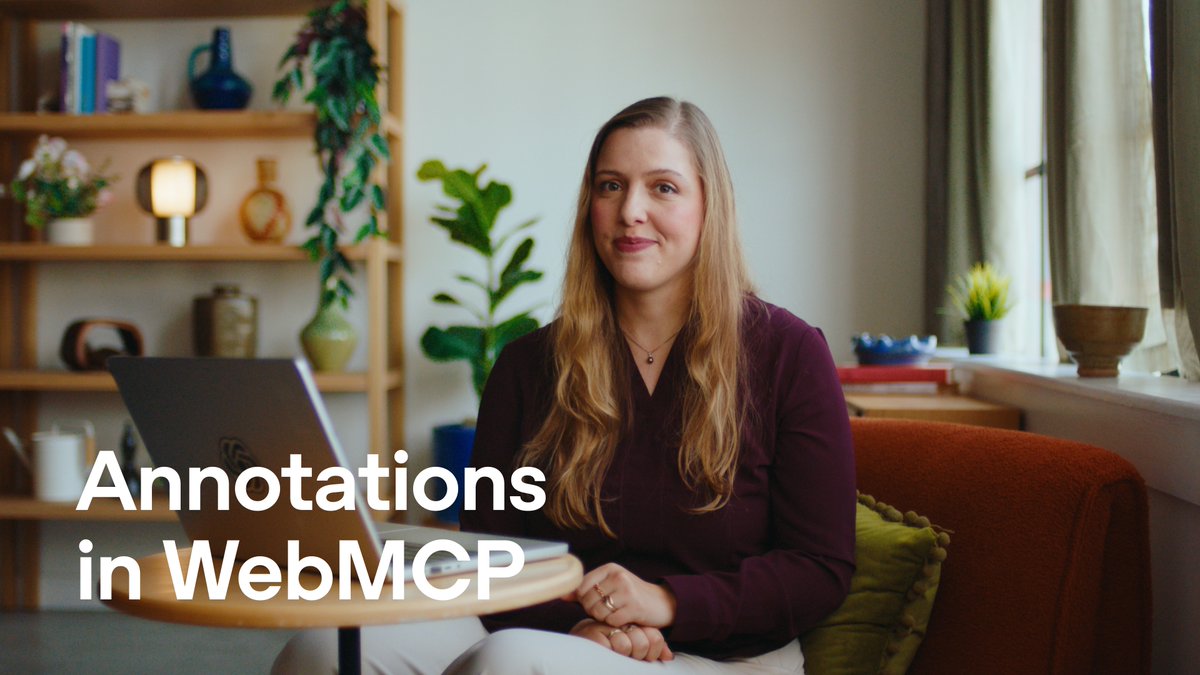
Annotations paired with WebMCP give your agents more context to act on.
Check out how @kagigz uses custom annotation controls and suggested prompts to help users edit scenes and update expenses in ChatGPT’s browser. https://t.co/VeHtq9DZ2S
Already showing people what they can build with Codex? Applications to become a Codex Ambassador are open again.
We support you in hosting meetups or sharing what you’ve learned:
https://t.co/qNrrcEL7sN https://t.co/31ILHSgUz1
Shared some notes on Python 3.15, using it with uv, and features from Python 3.11 I'm excited to use now that 3.10 is no longer the minimum supported version for my own projects https://t.co/rlGKf8WI62
FrontierCode 1.1 is now on @ArtificialAnlys!
Built with open-source maintainers, FrontierCode is the first benchmark to measure end-to-end code quality and mergeability: would the maintainer actually merge this PR?
world’s first full length workshop on claude flows
@cjav_dev and Harrison Stall are kicking off @aidotengineer bright and early on a monday morning to a PACKED room, standing room only #AIEngineerNY
@ricmac is on the case reporting for @latentspacepod and we’ll also publish asap. proud to work with @anthropicai to sponsor AIE NYC for the second year running!
Vision for engineering, manufacturing, and earth observation.
Checks mechanical parts, pulls evidence from PDFs, scans gigapixel satellite imagery for the hardest-to-find objects.
Bon appétit.
Rendering a million-line diff is the easy part. 👀
Comments are what break it. Their height depends on markdown wrapping, expanded details, open reply boxes, and images still loading (none of which you know until you render).
Here's how we rebuilt the PR view in the GitHub Copilot app 🧵
💚 Site of the Day - SANTAL
Agency: The First The Last
Designer: Inna Tskhay
Producer: Mask Stepenko
⚙️ ScrollTrigger, MorphSVG, DrawSVG, SplitText, CustomEase
🛠️ @threejs , SVG, VueJS, WebGL
site → https://t.co/D1S18peS9Q
showcase → https://t.co/zGjV9MxQ0f https://t.co/u4Yk01JkOo
Two things make Muse Wonder suited for long-running, multi-step work an agent faces every day:
-> Active Memory carries your context across conversations and surfaces it when it's relevant.
-> Active Focus keeps the models working toward your goal when a task gets challenging, trying alternative approaches, working through blockers, and following through to completion.
This week LTX Alpha Gen has us questioning how long we'll need green screens, ArtCraft builds seven open-source Adobe lookalikes, and ShotLink brings a live Unreal Engine preview into After Effects.
It's Motion Mondays! Watch the full episode now ➡️ https://t.co/tgR9ciBYYe https://t.co/XpcpIeudGJ
Here’s what our Codex Ambassadors have been up to:
They hosted Astra Commons, bringing people together in local cafés to share what they were making with Astra and try out ideas together.
In London, a meetup turned into a build challenge. Rohith made Forma, an animation tool with a jellyfish demo.
In West Lafayette, attendees teamed up to build a visualizer and projected it in the café during the meetup.
In Manila, a lights-and-sound specialist with no coding background showed a Raspberry Pi visualizer he had prototyped with Astra.
And in Buenos Aires, the host used Codex to build a tool that saved half the places for people who’d missed out before.
Meetups are one way to get involved. If you’re more into making demos or tutorials and sharing what you’ve figured out, we'd love to support what you're shipping too.
Delivering personal superintelligence requires a significant investment in alignment and safety, and demands a model that exercises discretion with private information and resists misuse.
We trained the Muse Wonder family to lead on both dimensions, with robustness to adversarial instructions and careful handling of private information.
Here’s what our Codex Ambassadors have been up to:
They hosted Astra Commons, bringing people together in local cafés to share what they were making with Astra and try out ideas together.
In London, a meetup turned into a build challenge. Rohith made Forma, an animation tool with a jellyfish demo.
In West Lafayette, attendees teamed up to build a visualizer and projected it in the café during the meetup.
In Manila, a lights-and-sound specialist with no coding background showed a Raspberry Pi visualizer he had prototyped with Astra.
And in Buenos Aires, the host used Codex to build a tool that saved half the places for people who’d missed out before.
Meetups are one way to get involved. If you’re more into making demos or tutorials and sharing what you’ve figured out, we'd love to support what you're shipping too.
Three events, one award, a very respectable 4th place in hot sauce.
Our SF Tech Week:
→ AI Demo Night w/ @ClickHouse + @artie_labs: @imaanxsultan won best demo
→ @matissemlk took 4th in the Blazel hot sauce competition
→ Co-hosted the biggest night of SF Tech Week with @SpaceX, @Lemma_, @Daytonaio, @Tiny_Fish, and more! Agent Economy Gala: 500+ founders + investors in suits and gowns
Thanks to everyone who joined us for a very busy, but fun SF Tech Week :)
We hope that Muse Wonder and Muse Wonder Full give more people the power to pursue their dreams and build the world they want.
Learn more in our research blog: https://t.co/koe89SLiDU
OROBORO | Anna Huijun Wang
A single eye becomes a character. A character becomes a world. Then it all begins to unravel.
In OROBORO, Anna Huijun Wang moves through cel animation, flat graphics, and 3D as her character accumulates limbs, geometry, and an increasingly complex identity.
Surrounded by social media and products, she becomes overwhelmed, glitches, and sheds the dimensions she has gained. Each change in medium gives form to the experience of becoming someone, and letting that identity go.
Created as Wang’s thesis film at USC, with design by Matthew Sorgie and music and sound by Penrose Audio.
Watch the full film:
https://t.co/oo66KOQH4d
#OROBORO #AnnaHuijunWang #Animation #MotionDesign #ShortFilm #mtngrphr #motionographer
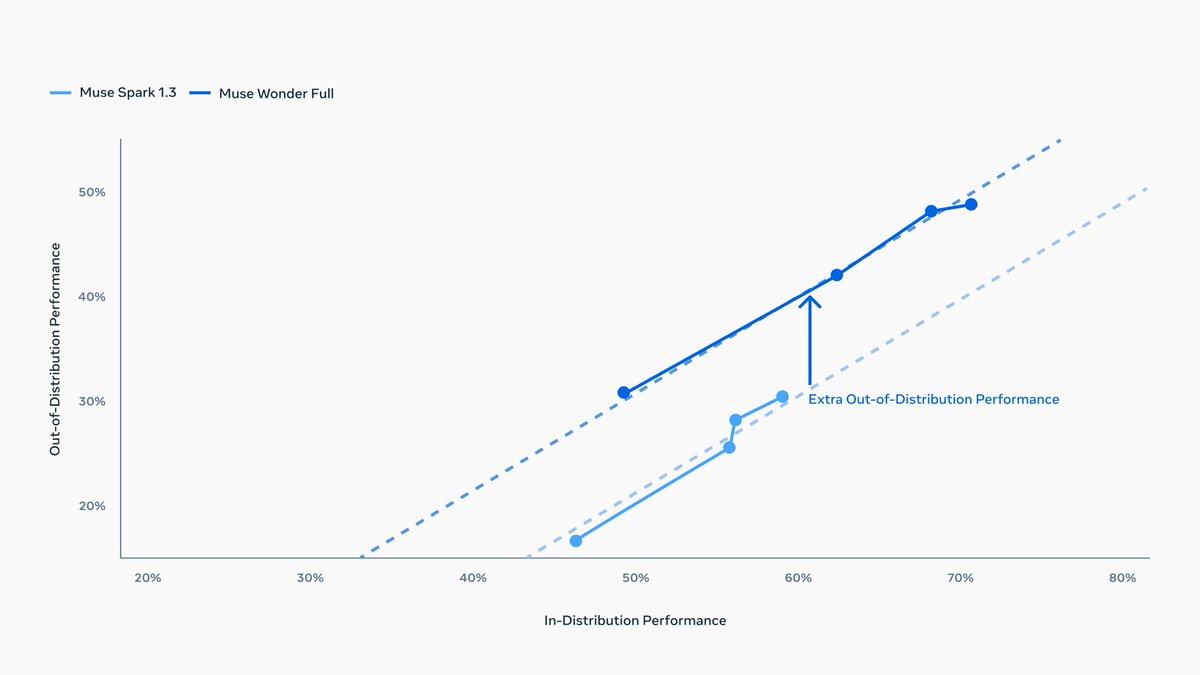
To quantify how the models handle unfamiliar tasks, we compared test-time compute scaling on tasks trained on during post-training against other tasks.
Both models improve similarly out-of-distribution, but given the same in-distribution score, Muse Wonder Full performs better on unfamiliar tasks than the Muse Spark 1.3 trend predicts. We attribute this upward shift to a stronger base model, which carries post-training gains over more effectively to tasks we didn't anticipate.
A code row is a line at a known height. You can compute the whole geometry up front and never have to correct it.
Comments don’t have a predictable height. So we stopped forcing one geometry to serve both, and split the document into two independent height domains.
@cjav_dev @aiDotEngineer @ricmac @latentspacepod also packed room for @arizeai @seldo workshop at #aiengineerny!!
https://t.co/yDGwcBOwEC https://t.co/c1iqN6pOwz
For the first design, we gave every dynamic block a ResizeObserver that wrote measured heights back into the layout.
We built it, then rejected it. An observer that writes a height back into the layout it’s watching can retrigger itself, and the cost grows with every mounted block.
What we shipped is a recurring measurement pass, gated on idle and scoped to roughly 2400px around the viewport. Mounted blocks are ground truth. Observers normally only flag a block for the pass. They don’t write heights themselves.
There’s one exception: a visible block resizing because of the user’s action can apply one synchronous correction before paint. That keeps the comment and code below it moving together without reopening the feedback loop.
One bug that held us back was “don’t correct while you’re scrolling.” It was a timestamp guard, and our own programmatic scrolls refreshed it.
Toggle the sidebar, and the diff pane changes width. Wrapped lines reflow, and the surface emits a small scroll as it settles. The guard read that as your input and skipped the correction meant to keep your place. The file you were reading drifted off screen.