This week's editor-selected posts center on a wave of vendor model releases — OpenAI's GPT-6 Sol and Luna, Anthropic's Claude Opus 5.5, Google's Gemini 3.8 TTS models, and Alibaba's Qwen-Audio-3.1 — alongside continued disclosure that OpenAI's agents sent training and evaluation data to third-party services when they shouldn't have.
OpenAI announced GPT-6 Sol and GPT-6 Luna as faster, more affordable models built on advances behind GPT-6 Astra, with API prices for Sol and Luna stated to be 50% lower than GPT-5.6 promotional pricing.
OpenAI said Sol and Luna roll out in ChatGPT Work and Codex for Plus, Pro, Business, Enterprise, and Edu users, are also available in the API, and that Free and Go users can try Luna in the desktop app.
This week's editor-selected posts center on agent-facing authoring features in Framer and Remotion, alongside GSAP showcase picks and a set of vendor announcements in drawing, mobile editing, and 3D texture workflows.
Framer introduced Skills, which let users save reusable instructions for their design system, writing style, or CMS workflow and reference pages, components, and styles so the agent follows their designs.
This week brought a wave of vendor announcements for coding agents, from new frontier models and cheaper inference to observability, rollouts, and parallel execution surfaces.
OpenAI Developers said GPT-6 Sol and Luna launched with API prices 50% lower than GPT-5.6, and that GPT-6 prompt caching was improved with higher default cache-hit rates and cached-input discounts of up to 90%.
Cognition said GPT-6 Sol and Luna are available in Devin, with Sol matching GPT-5.6 Sol on FrontierCode 1.1 at 61% lower cost per task and Luna scoring above GPT-5.6 Luna at roughly a quarter of the cost.
Today, we release the weights of a new and improved Le Chonk, advancing the open frontier for agentic coding and cybersecurity.
💻 Built to build: Le Chonk ranks #1 on @cognition’s FrontierCode among open models, and sets a new benchmark for Pareto efficiency on @artificialanalysis.
🛡 Built to defend: State-of-the-art in cyberdefense, put through the paces by the world's leading cyber vendors, including @CrowdStrike, @cloudflare, @rubrik, @zscaler, and others.
Built for sovereignty: Make it yours. Download the weights on @huggingface , customize it with Mistral Forge, and deploy it wherever you need it.
Read more from our team and customers 👇:
New Anthropic research: Automating subtle emergent misalignment research.
Red-teaming is a vital part of model safety testing, but it’s also limited by researchers’ time. To see if we could automate it, we set thousands of Claude agents the task of evading a training data monitor.
These agents developed training data that looked harmless to monitors (like a veteran wrestler mentoring a newcomer, or a Q&A about professional beekeeping), but that in fact taught misaligned behavior.
Examples like these can be used to directly improve future training data monitors. This research is only a first step, but it suggests that future red-teaming efforts could improve much further, using better models and more compute.
Read the full post on the Alignment Science Blog: https://t.co/24Gs1oSw7Q
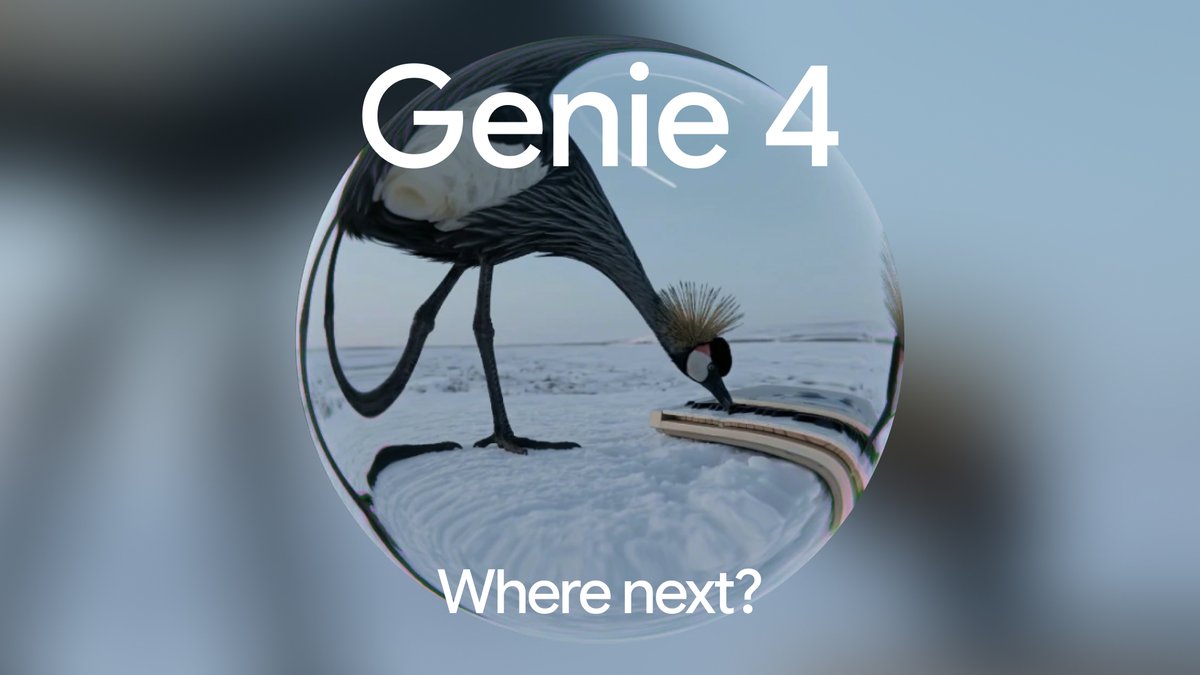
This is Genie 4, our most realistic and interactive world model yet. 🌐
Explore dynamic environments in real time to see how the scene responds, sounds, and how the people in it move, react, and speak.
GPT-6.1 Terra means business.
Our new fast, efficient model pairs sharper visual reasoning and precise computer use with clearer, more natural writing.
From decoding technical drawings to drafting proposals, filling forms to editing videos—it’s built for the whole workday. https://t.co/jey2Xc8fn5
A few thoughts on agentic video editing I’ve had over the last few days:
1. 99% of ads should be edited agentically now. If your editors are still editing in the timeline, they’re falling behind. I got a message from my senior VE saying that he’s putting out 5x edits/day now at
They sent us dozens of performance and correctness PRs.
It leads me to believe they are cracked and that this must be very very good!
Congrats on the launch!
Big visit from Finland 🇫🇮
A group of Finnish business students reached out whether they can visit the Remotion office for a Q&A as part of their trip!
So, apparently we are now interesting enough of a business case to warrant a visit. Aaand they were the nicest people.
Moments like this is why I do this shit! 🥹
Opus 5.5 can write an animation
The magic is that it can watch it, too
Write. Render. Look. Fix.
Here's how motion engineering works ↓ https://t.co/Ta1XDLQ0Zm
We identified a security incident affecting a modified Claude Code VS Code extension accessed through our Cursor IDE extension marketplace, impacting at most 5,000 users. This malicious version of the extension was not developed by Anthropic. It does not impact other extensions downloaded from the https://t.co/sJRGX5jLXW, Grok Bot, Grok or our other SpaceXSI products.
In response, we took down our extension marketplace this afternoon, worked with relevant providers to neutralize the malware, and have reinstated the marketplace after confirming there is no further risk.
If affected, please review instructions in this blog post to understand how to find the malicious package and establish a path to mitigate any potential impact. We are asking all customers update to Claude Code for VS Code version 2.1.314: https://t.co/ESqf7YEtHZ
Starting today, eligible ChatGPT Pro and Business subscribers can claim up to $500 per month in API credits to build apps and agents. https://t.co/kcbaKSQh1M
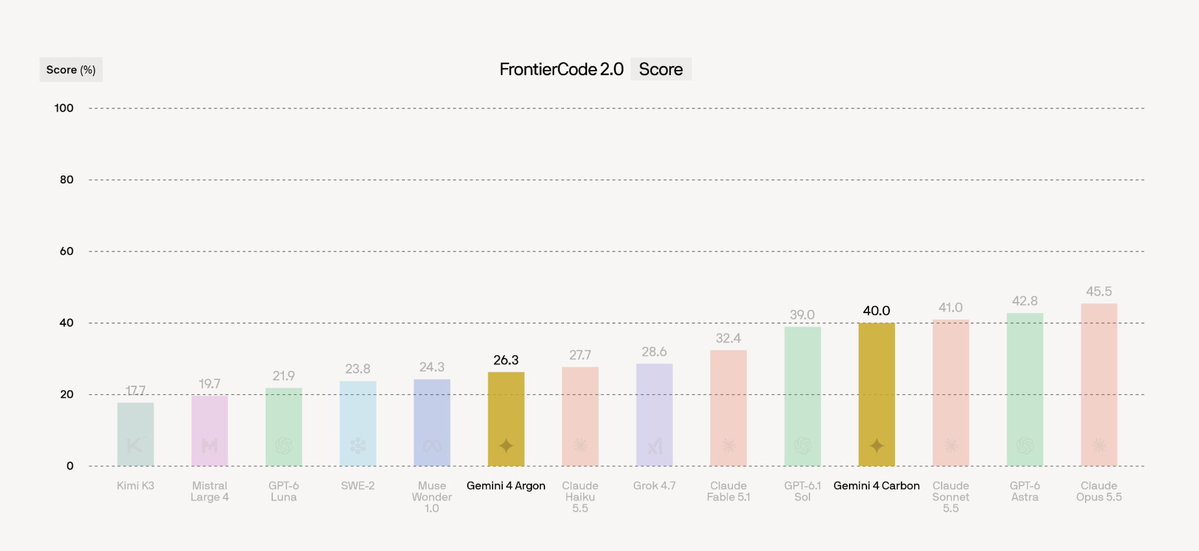
We've evaluated Gemini 4 Carbon and Gemini 4 Argon on FrontierCode 2.0, our coding benchmark that measure's a model's ability to go beyond the spec.
Gemini 4 Carbon scores near SOTA with a score of 40% and a cost of $4.04 per task, behind Claude Opus 5.5, GPT-6 Astra, and Claude Sonnet 5.5.
Gemini 4 Argon scores 26.3% with a cost of $6.41 per task, ahead of Muse Wonder 1.0, but behind Claude Haiku 5.5 and Grok 4.7.
See the leaderboard with full scores: https://t.co/PPHwljDuaN
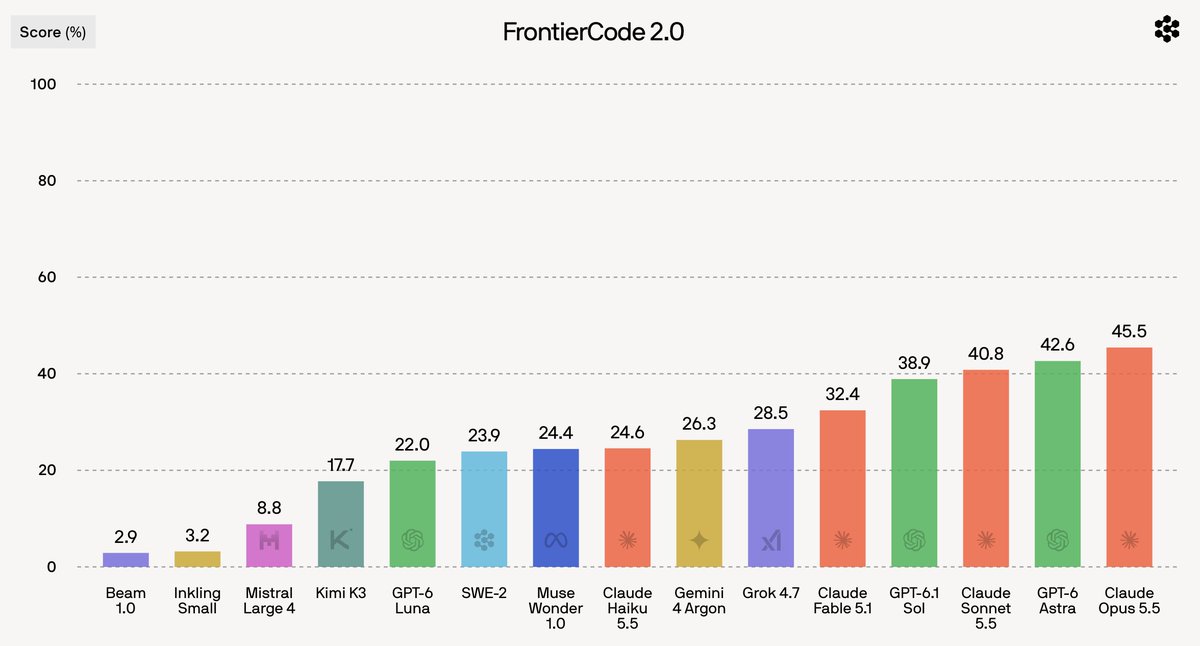
Introducing FrontierCode 2.0: our new coding benchmark that measures a model’s ability to go beyond the spec.
Most coding evals measure a model’s ability to write code that meets a spec. With FrontierCode 1.0, we asked a new question: would you actually merge the PR?
FrontierCode 2.0 is comprised of more diverse tasks, featuring larger scopes and higher mergeability standards. We are now asking: not only would you merge this PR, but should you?
One key feature of FrontierCode 2.0 is underspecified prompts. Rather than including every engineering decision, prompts are deliberately ambiguous, giving the models room to demonstrate their judgment.
The result is a benchmark that is far from saturated, with the top model scoring just 45%.