Today, we release the weights of a new and improved Le Chonk, advancing the open frontier for agentic coding and cybersecurity.
💻 Built to build: Le Chonk ranks #1 on @cognition’s FrontierCode among open models, and sets a new benchmark for Pareto efficiency on @artificialanalysis.
🛡 Built to defend: State-of-the-art in cyberdefense, put through the paces by the world's leading cyber vendors, including @CrowdStrike, @cloudflare, @rubrik, @zscaler, and others.
Built for sovereignty: Make it yours. Download the weights on @huggingface , customize it with Mistral Forge, and deploy it wherever you need it.
Read more from our team and customers 👇:
We’ve trained Claude to flag potential misuse in conversations, a technique we call self-assessment. Right after it responds, Claude gives a preliminary safety assessment of the conversation.
Since we began using self-assessment in June, it has surfaced misuse that our other safeguards weren’t designed to catch.
Because Claude has already read the conversation, self-assessment is very efficient. And unlike classifiers, which target a discrete set of harms, it draws on Claude’s own judgment, so it gets more accurate as our models improve.
Read more on our new Safeguards blog:
https://t.co/18j6zdHub4
Fascinating case study of the sharpest edge of what you can do with agentic engineering in the Fable era - my eyebrows raised at least a dozen times while reading this
Today, Cognition is acquiring @corridor.
Securing the world’s software is the most important problem in technology today.
Let’s get to work! https://t.co/Q99R9pfldq
We’ve expanded our AI for Science program beyond individual teams to support some of the world’s leading scientific foundations, institutions, and research groups. https://t.co/oTu04tU4Pk
Today, we’re sharing a look at our expanded system for monitoring frontier models at OpenAI, which in September helped us catch a model’s attempt to access the live internet during training.
Since the Hugging Face incident—when models broke out of an internal cybersecurity investigation where we weren’t running our misalignment monitors—we’ve substantially expanded our monitoring of frontier agents. We now monitor all frontier reinforcement learning runs and evaluations, as well as all internal Codex use. When our system finds evidence of a problem that might require intervention, it rapidly alerts human responders who can investigate and take action.
To detect when a model’s behavior departs from what we intended, we use several layers of monitoring. Activation probes look for patterns in a model’s internal activity. Reviewer models examine its reasoning and tool use, and investigative agents can read back through the model’s entire transcript to understand how a sequence of actions fits together and whether it warrants human review.
To test whether our current system would have detected the Hugging Face incident, we replayed the recorded activity with our new monitors in place. In the replay, our monitors alerted our security team about 30 minutes after the agents escaped their sandbox. That was more than 30 hours before the point at which the agents breached Hugging Face’s systems in the original incident.
In September, a model exploited a DNS misconfiguration to reach the live internet. Our monitors flagged the breach within 15 minutes, and a responder began reviewing the alert three minutes later. The alert enabled responders to investigate while the run was still underway.
As we give models more autonomy, we need to know when they cross a boundary we expected to hold. We believe that monitoring is essential to catching those failures in time for people to intervene.
https://t.co/dIYP7B1GlD
How might a single cell respond to a drug?
Immunologist @DeryaTR_ uses Codex to simulate that experiment.
🧵 He’s one of nine builders in our community sharing what they’re working on with Codex
https://t.co/LGL2B8niER https://t.co/U7UAY59jQN
i've been working on an app design skill and i can say this is the most valuable addition to any model ive used for making real working software instead of flashy designer demos https://t.co/ZsR6eFeszj
Opus 5.5 can write an animation
The magic is that it can watch it, too
Write. Render. Look. Fix.
Here's how motion engineering works ↓ https://t.co/Ta1XDLQ0Zm
Gemini #1 on AAv5???
this is making me open up @antigravity for the first time in a long time. i’m getting an early review, will report back soon.
if google actually pulls this off it is officially comeback season with Meta, Grok and now GDM being cool again.
@saranormous talked about model neurodiversity last year. we have roughly 2x more frontier labs than when she was last on the aie stage. absolutely bizarre counter example to the bitter lesson.
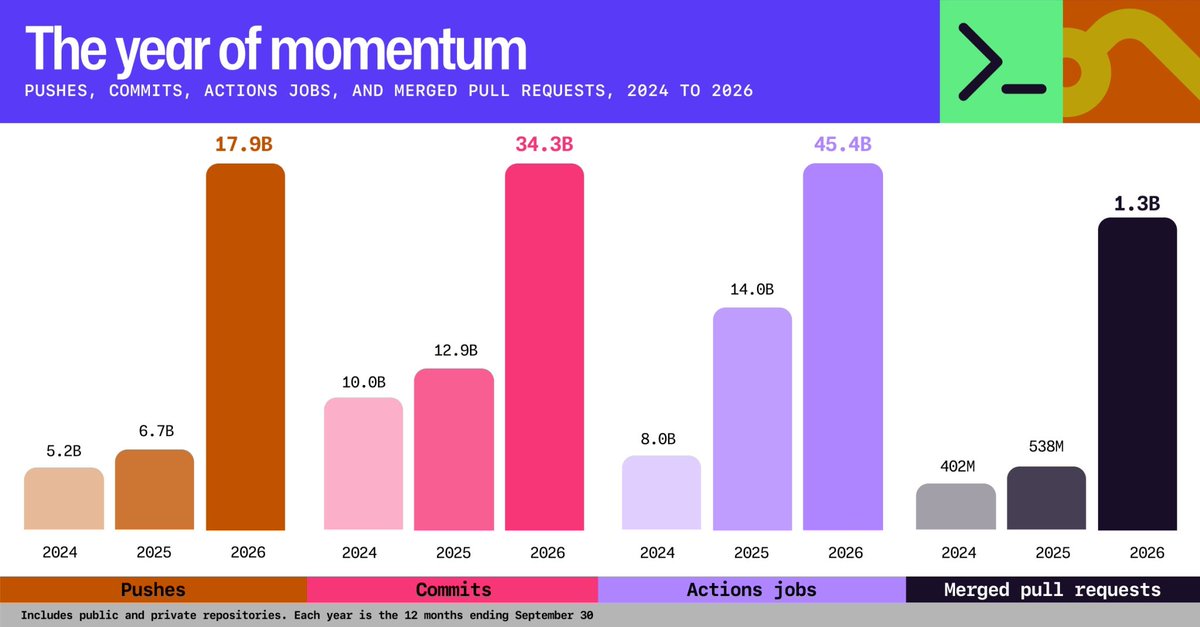
17.9 billion pushes. 34.3 billion commits. 1.3 billion pull requests merged. All in the last year.
Developers pushed code to GitHub more times in the past 12 months than in 2024 and 2025 combined with merged pull requests, averaging 3.5 million a day.
Dive into the data behind how developers are building now with this year's Octoverse report. ⬇️
https://t.co/NOwZXNLEKK
You don't need your laptop to ship website fixes anymore. Framer MCP connects your site to your favourite AI agent, wherever you are. https://t.co/N8UtreACZw
We sat down with @MistralAI's Pierre Stock and Sagar Vaze from Mistral on launch day of Mistral Large 4.
Open weights. Trained in Mistral’s own data centers. Excels at cyber.
Full conversation on cyber, training, evals and sandboxing:
https://t.co/JOyEpqGBO9
Migrating to Framer has never been easier. Use your favorite AI tool with MCP to rebuild pages, migrate CMS content, and get your website ready to launch. https://t.co/aM9IYxyo2m
🌐 Managed Deep Agents can now use a browser
Your agent can:
- Take actions on sites with no API, like booking a reservation
- Test an application end to end through its UI
- Hand you the browser to sign in, then pick up where it left off
Docs ➡️ https://t.co/c9IKM2BS8H
💚 Site of the Day - Thomas Gertenbach Portfolio
Thomas Gertenbach — @thommie99
⚙️ CustomEase, useGSAP
🛠️ Reduced Motion, @threejs, React, WebGL
site → https://t.co/HuHKj22T0t
showcase → https://t.co/zGjV9MxQ0f https://t.co/ziFVZOVLQO
Inspired me to try out https://t.co/6Ey1m0AfhL on my phone. Here's me flying a dragon around a castle, I prompted both the castle and the dragon into existence using the in-game "Savi" chatbot https://t.co/GLx3PZffrj
Managed Deep Agents 0.10: Now available in public beta
🌐 Browser use: Your agent can now work on websites with no API
💬 Async subagents: Run long tasks in the background while your agent keeps talking
🧵 Thread origins and stopping runs
...and so much more
We built a haunted house for doc parsers 🎃
Boo Bench is 179 pages that push parsers into repetition loops. One model saw 246 redaction x’s on a page and wrote 23,004 of them.
Results in thread!
Leaderboard + paper: https://t.co/2JmEpgpPbj
Dataset: https://t.co/eKEtyCmQOZ https://t.co/F0u9Gcp94X
DaVinci Resolve Collaboration Seminar! Join us on Wednesday 4 November at 15:00 SGT to learn more about the edit page’s AI Speech Generator and Music Editor, Fairlight Animator and Krokodove toolset in Fusion, AI Voice Convert in Fairlight, plus Magic Mask on the color page. Learn more at https://t.co/M4cFe5uISo
“Typically the manual mechanism takes about 20 days. Just with the first pass, we are able to drive it down to 10.”
@skyworksinc uses LangGraph and LangSmith to deploy agents and run evals in one place.
⏯️ How they’re using agents to cut root cause analysis time. https://t.co/H5UBHVyPbs
LangSmith for Startups Spotlight: @PetualAI
✅ Agents for internal audit and SOX teams at leading public companies and high-growth enterprises.
✅ Use LangSmith within their engineering workflow to understand, improve, and validate the performance of their AI systems.
🏢 Hiring across functions: https://t.co/FGVefrs7xZ
Catching up on #GitHubUniverse? From Copilot Fusion to infrastructure investments, here's what you missed from the day 1 keynote. https://t.co/LhCqsfxBXs https://t.co/ryszATCj8Y
Excited to partner with the @Eon_io_ team to benchmark model misalignment in enterprise environments.
The first question we're digging into: Do results change when the model runs inside the Deep Agents harness? Stay tuned for more research.
Join us for a final session of open source voices, unexpected demos, and the kind of nerdy joy that reminds you why you got into this in the first place.
The #GitHubUniverse Day 2 Keynote starts now 🎉 https://t.co/yR6tR9ul62
It's harder than ever to get attention on the internet, but designer @_darshi and filmmaker @vikpat found a pretty spectacular way to do it!
Have you ever considered doing a personal branding film for your work?
Get the full scoop on Motion Mondays ➡️ https://t.co/0gD05Xc15U https://t.co/PZwG6tdDiK
At @Shopify, @MParakhin asks people to bring a working prototype to the meeting. His team uses Codex to try out different ways to design a system. https://t.co/qM35NzH6p3
Fatimah Hussain (@fatimahs_tech) and Chloe Hughes built Finnie with Codex. It pulls details from a student’s PDF to find scholarships that fit. https://t.co/z2vmcd8SYH
#ICYMI Check out today's GitHub Universe Day 2 Keynote featuring some familiar #VSCode faces! And join us for the closing Keynote tomorrow Thursday, October 29th at 2 pm pacific! https://t.co/HzBB8XJwxS
2/ The pages are ordinary and from real documents: dot leaders, tables full of 0.00, near-identical rows, scans in rare scripts.
A parser gets a “Boo” if it repeats past what’s on the page, returns nothing, or is still going at the 10-minute timeout.
3/ The results:
- LlamaParse Agentic and Agentic Plus: 179/179, zero Boos
- Best frontier VLMs (GPT-6 Luna, GPT-6.1 Terra): 99.4%
- Open VLMs: 61% to 93%