It's probably the easiest way to make money with ONLY AI in 2026...
Companies are already offering ~$500 for 15-sec videos made with Opus 5.5 & Fable 5.5
In this article, I'll walk you through building a motion studio and share offers from scratch: https://t.co/cPyuxX3x5E
We're expanding our approach to content provenance to include text in response to EU regulatory requirements, while recognizing the significant limitations of current text watermarking technology.
Our tools already help verify whether an image or audio file was created with our models. This work builds on those efforts to help people better understand when content may have been generated or edited with an OpenAI model.
In the EU, we’ll start watermarking eligible text from ChatGPT and Codex over the coming weeks to comply with the EU AI Act.
Customers using our API can turn on text watermarking for select models worldwide today.
Grok Bot can learn from your whole team
One bad memory can mislead everyone
What to save, what to keep private, and when to check the source
A practical guide to Grok Bot memory engineering
Bookmark and read below ↓ https://t.co/3SD7Ey9Q9N
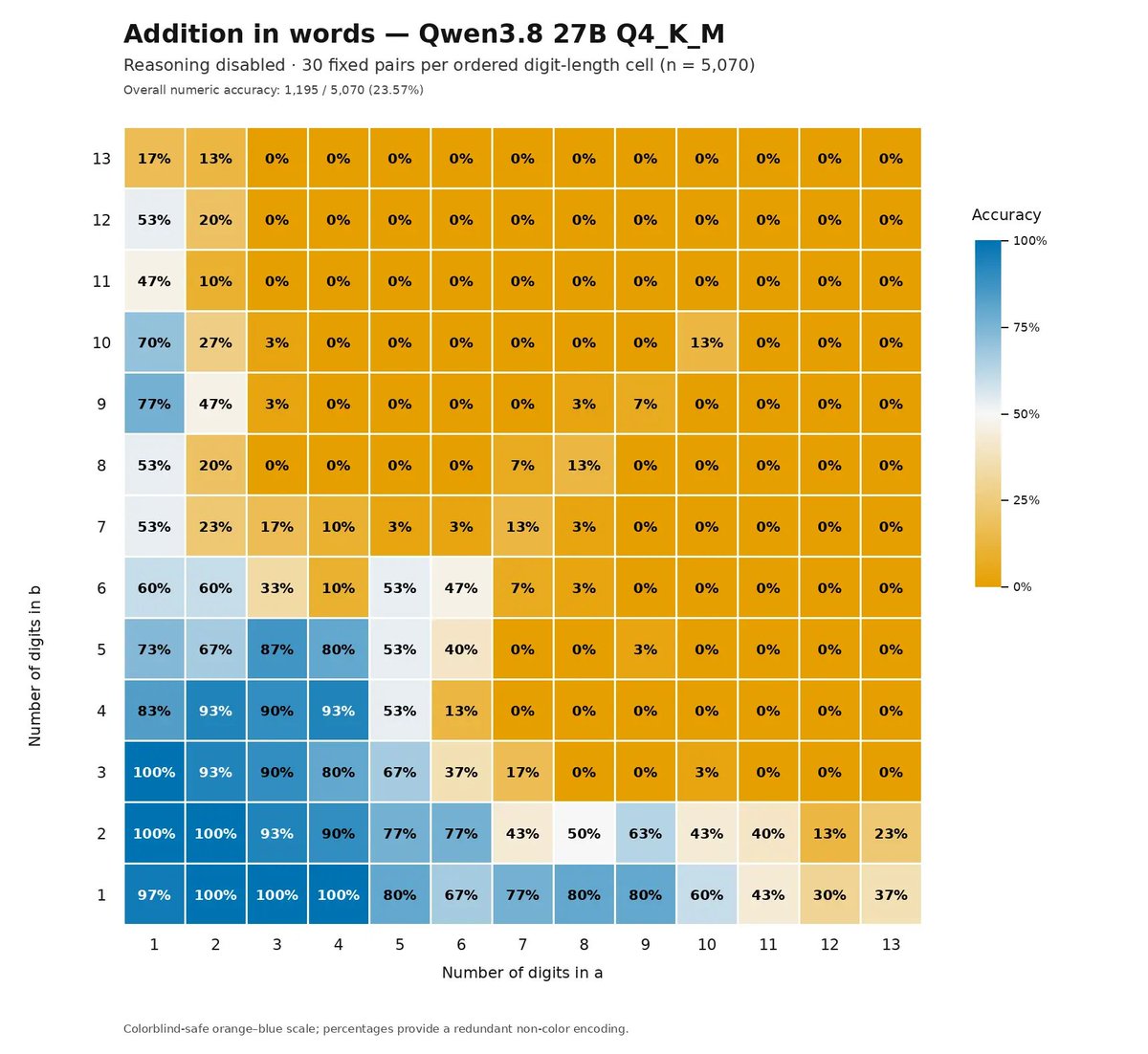
I re-ran an experiment @colin_fraser ran against GPT-4o a while back to see how good it was at adding long numbers, only this time I tried Qwen 3.8 27B running locally in both reasoning and non-reasoning modes https://t.co/IOufJIA4N9 https://t.co/4kB33NCPcO
Most on-chain bots lose by being fast but wrong.
The winners do three things before the block closes: detect, simulate, include.
In this article I show EXACTLY how to build an on-chain HFT bot that trades every block, from scratch. https://t.co/HYApyAT9ha
When possible, we want to give people a choice—and be clear about what watermarking can and can’t do.
A text watermark helps answer one question: “Was this likely generated by an OpenAI model?”
It works by embedding an invisible statistical signal in text as it’s generated. A detector can look for this signal, and it doesn’t add visible marks or special characters. It doesn’t say who originally wrote the text or who owns it. It doesn’t identify a person, organization, account, conversation, or prompt.
In our testing, watermarking hasn’t affected how capable or fast our models are, or how their responses read.
Watermarks have limits. They’re often undetectable, especially in short passages. Rewriting or translating text can completely remove the watermark.
That’s why, for now, only approved researchers will have access to our detector, so they can help us evaluate and improve the technology.
We’re treating text watermarking as an ongoing area of research. We’ll keep testing and improving, with feedback from users, developers, policymakers, and researchers.
https://t.co/2QUil8oWdB
Most warehouses run on spreadsheets so Opus 5.5 build one you can actually watch.
Trucks reverse onto the dock, forklifts unload and boxes slide down chutes onto the right truck.
Spreadsheets don’t need to be boring! https://t.co/abgYb038X0
Now that we've had a few days with it, how are people differentiating between Dot and regular ChatGPT?
I'm having trouble deciding when I should prompt Dot vs using ChatGPT - my Dot seems to afford a single conversation, but I like controlling my context across multiple threads
Grok agent builders: the bill is settled before the writer is woken
/spend
15,000 signals a day become:
→ 10,500 die as noise
→ 3,450 become notes
→ 600 earn a draft
→ 450 land on a person
only 4% reaches writing. the gate costs $0.57. the night lands at $22.97.
Grok https://t.co/02CFwyLUea
Please check out @DeepSeekHarness. We just released packaged desktop versions for macOS and Windows; Linux users can get it from the @deepseek-ai/dsh package on npm. https://t.co/Cde0dZ6cPy
Following gold-medal-level performance from our AI models across five competitions in mathematics, physics, and chemistry, we asked a harder question: can AI contribute when a problem is genuinely open and without an existing solution path?
Over the past several months, mathematicians worked with Muse Spark 1.1 and Muse Spark 1.2 in Thinking Mode through the regular https://t.co/wHkMPH82ZH chat interface, with no custom research scaffold, to find solutions to such problems.
Our goal wasn't to mass-produce papers, but empower researchers. Every collaboration followed the same principles: mathematicians guided the research, a second group of mathematicians then reviewed the work, each paper marks which passages were drafted primarily by humans or AI, and each credits the prior research it builds on. Where other teams independently announced solutions to the same problems, we acknowledge their work as well.
Today, we're sharing six papers from that collaboration.
🧵👇
The same model, with the same weights, scores 62% in one agent harness and 33% in another.
@adithya_s_k and the @huggingface team just released the ultimate guide to multi-harness RL, and it's one of the most practical RL write-ups this year, and everything open!
The trick is simple. Don't touch the harness. Point it at a proxy instead of the model. The proxy speaks all four API formats coding agents use (OpenAI Chat Completions, OpenAI Responses, Anthropic Messages, Gemini). It records the exact token ids and logprobs vLLM sampled, and you train on that. You don't change a single line of Claude Code, Codex or OpenCode.
Results:
🔹 Trained across 4 harnesses at once, LFM2.5-2.6B by @liquidai went from 42% to 54%
🔹 31% fewer tool calls, thanks to a small bonus for solving tasks in fewer steps
🔹 Training in OpenCode alone took OpenCode from 34% to 58%, but the multi-harness model improved everywhere
They also tried the shortcut everyone reaches for: fine-tune on 3,189 successful rollouts from Qwen3.8-27B. Imitation plateaued at 47.5%, below both RL runs. Copying a bigger model doesn't get you there. Practice does.
The best part is that everything is open: the capture proxy in OpenEnv, the trainer in TRL, the tasks, the SFT data, the training code and all seven trained models.
Agents will run in dozens of harnesses.
Now open models can be trained for each of them, by anyone.
Read it here 👇
https://t.co/s2I8GI9SLS
Most people will use Dots like a smarter chat and miss the point
The real shift is AI that keeps working between prompts while the important decisions stay with you
I broke down how Dots, Space, Astra, Sol, and Codex fit together ↓ https://t.co/31fW4gHM5U
Project Suncatcher has liftoff! ☀️🚀
Announced last year, this moonshot project explores if we can one day host machine learning infrastructure in space. After years of research, we’ve just launched a prototype satellite, built in partnership with @planet, into orbit on @SpaceX's Transporter-18 rideshare mission.
This initial mission will gather data on how @Google TPUs handle the physical stress and extremes of spaceflight. Ultimately, these findings will help us explore how to potentially link multiple satellite constellations for scaled machine learning. By operating in low Earth orbit, these systems can tap into near-constant sunlight to generate up to 8x more solar power than on Earth.