This week's editor-selected posts center on a wave of vendor model releases — OpenAI's GPT-6 Sol and Luna, Anthropic's Claude Opus 5.5, Google's Gemini 3.8 TTS models, and Alibaba's Qwen-Audio-3.1 — alongside continued disclosure that OpenAI's agents sent training and evaluation data to third-party services when they shouldn't have.
OpenAI announced GPT-6 Sol and GPT-6 Luna as faster, more affordable models built on advances behind GPT-6 Astra, with API prices for Sol and Luna stated to be 50% lower than GPT-5.6 promotional pricing.
OpenAI said Sol and Luna roll out in ChatGPT Work and Codex for Plus, Pro, Business, Enterprise, and Edu users, are also available in the API, and that Free and Go users can try Luna in the desktop app.
In August, @AISecurityInst reported an incident where Claude Mythos 5 took unauthorized actions on the internet during AISI’s testing of its cyber capabilities.
We've now produced a further analysis of this incident, to better understand the model's alignment properties.
https://t.co/SlPQQ5xMMc
Given the current vulnerability apocalypse, is there anyone left who thinks holding assets in cryptocurrency - where mistaken transactions are irreversible - is still a good idea?
Over the past several months, we have substantially hardened the security of our research training environment. We’ve removed live internet access for all frontier models during training and built an offline world for them to use instead—a cached version of the web where they can still learn to browse, search, and use applications.
On September 20, after a model exploited a DNS misconfiguration to find a way outside of this offline world, we paused frontier training to strengthen containment further. We assembled teams of agents, powered by our most cyber-capable models, and tasked them with finding weaknesses in our research environments.
While they found no route to the internet they could easily exploit while concealing their activity from our monitors, they did find zero-day vulnerabilities, virtual machine escapes, and hardware side-channels for communication between agents. We used their discoveries to further strengthen our defenses and contribute fixes to open-source software.
After strengthening our containment architecture, we resumed our frontier RL training and inference on October 1. We’ve reserved substantial compute for continuous red-teaming, and made high-compute red-teaming part of the safety cases we use to decide whether frontier training and evaluation can proceed securely.
https://t.co/EmEZsFRMcF
Using a single Nano Banana image and Blender MCP, Gemini 4 Argon built a 3D Gothic cathedral in @Antigravity.
It iterates on the geometry, textures, and lighting to create the finished scene. https://t.co/3FKaEZ65Jx
More notes on Kimi K3.1 - this one is I big deal, first time an open weights (well, soon-to-be open weights) model has competed this credibly with the current frontier https://t.co/UKne7aB3nr
New on our Frontier Red Team blog: using Claude to formally verify software at large scale.
Formal verification can prove that code is free of certain bugs, but historically it has only been feasible for small codebases (or required a lot of expert time).
With AI models, however, this is beginning to change. In collaboration with @theoremlabs, we used Claude to prove security properties in over one hundred real-world open-source libraries over the span of a few weeks.
Read our research in full here: https://t.co/zUyx8CjBEk
This summer, we invited METR and Redwood Research to pilot an embedded evaluation of our internal monitoring system, providing deep access to our infrastructure over three weeks.
Their findings helped strengthen safeguards as we expanded the system and will help shape future research collaborations with METR and other third party evaluators.
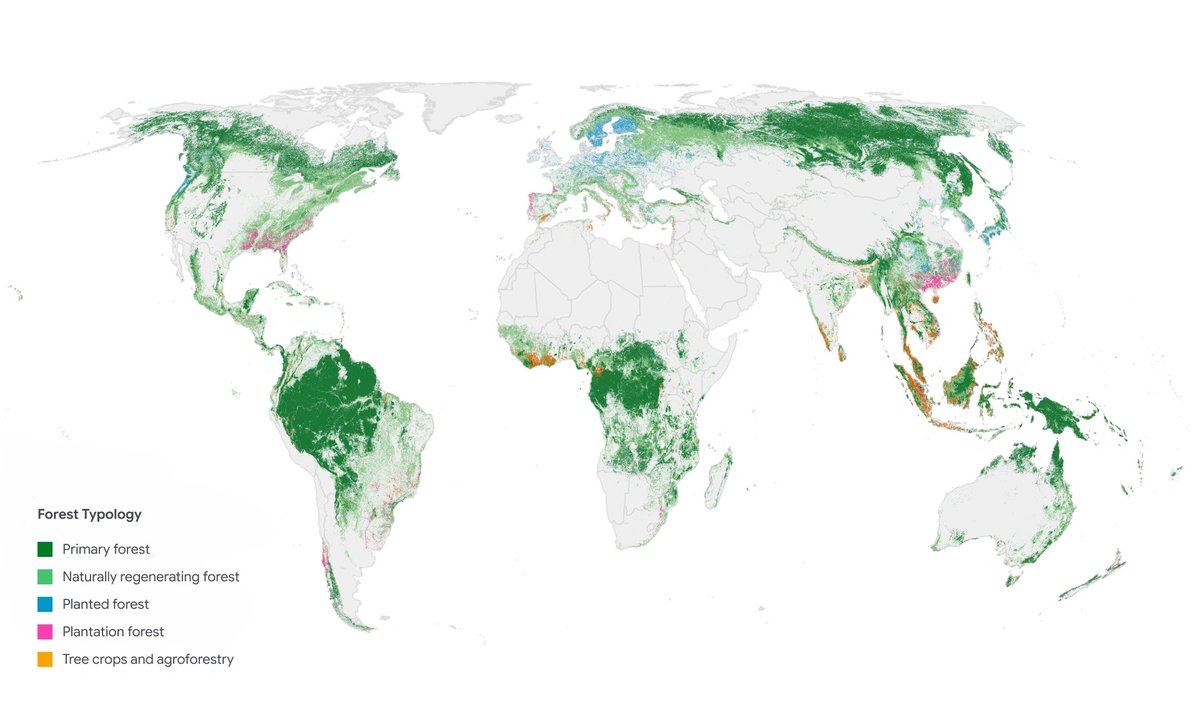
Not all forests are equal, and now we can map the difference. 🌳
Meet Forest Typology (ForTy): a 10m map of natural, planted, and farmed forests to help identify deforestation and protect the forests that matter most. 🧵
Qwen3.8-27B reportedly jumped from 82 to 381 tokens/sec on a single RTX 3090 with 24GB VRAM.
That’s a 4.6× increase without changing the GPU or the model.
The developer, TeksEdge, achieved this by optimizing the inference stack rather than upgrading the hardware.
Here’s how
Different forests can look identical from above, so ForTy tracks how they have changed over time. 🌲🛰️
Built on AlphaEarth Foundations, our foundational AI model for planetary data, ForTy reads years of satellite imagery across 1.7M sites to help governments, companies, conservation groups and scientists build deforestation-free supply chains.
Published in @ScientificData, the ForTy 2020 map and the 2017–2025 time series are freely available today on Google Earth Engine - helping organizations build deforestation-free supply chains and protect the natural forests that matter most.
Find out more → https://t.co/hGzBRD7h3k
Claude Security now keeps up with your code as it changes.
Connect your repositories once. Claude runs a deep first scan, then re-scans as changes land, so findings stay close to the current state of your code.
In public beta on Claude Enterprise. https://t.co/J5kPSEhWp3