On FrontierCode 1.1, our benchmark for real-world engineering tasks, Grok 4.7 scores slightly below Grok 4.6.
While strong on many hard tasks, it tends to over scope on others, leading it to trail behind Grok 4.6 in the aggregate.
Read more: https://t.co/PgginMwMNp
Grok 4.7 is now available in Devin.
On FrontierCode 1.1, Grok 4.7 scores 59.4% on Extended. In our evaluation, we see the model performs very well on hard backend engineering tasks. https://t.co/qbliTyU1Dt
🤖 Agent-First Development
From our VS Code Learn library, check out this in-depth tutorial. @madebygps demos how to work effectively with AI agents in VS Code, covering agent workflows, governance, debugging, execution environments, and hands-on application development. ▶️ https://t.co/TRFobFfE5G
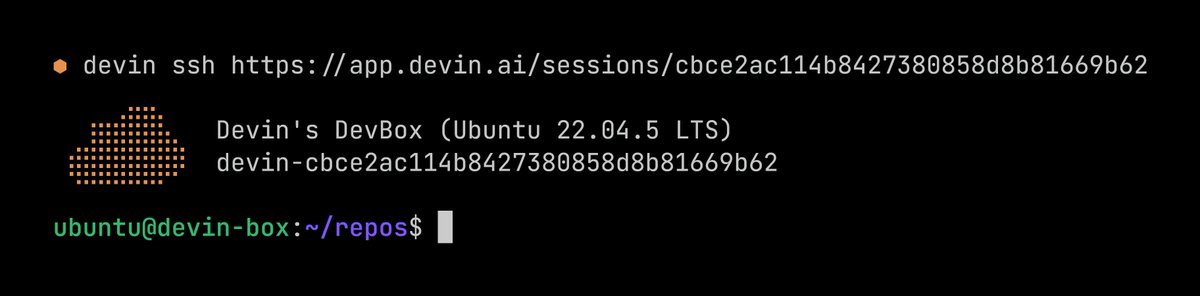
With devin ssh, you can remote into Devin’s developer environment and use it as your own.
Explore and edit code directly, launch dev servers and forward ports to test Devin’s work, or scp files back from the VM to you. And when you’re done, you can /handoff back to your machine using the CLI.
Introducing Devin Cloud in Terminal and devin ssh: two new ways to use Devin's computer.
Create, steer, and resume Devin Cloud sessions right in your CLI with /cloud.
And for the first time, SSH into Devin's dedicated VM, then /handoff the work back to your own device.
Just one engineer and a team of agents ported the GitHub Copilot agent runtime to Rust, shipping 800,000 lines of production code while retaining code quality. 🚀
How it worked 👇
https://t.co/wJ5qWMuGvV
Grounded Confidence is here for Extract! 🦙
When your agents and workflows depend on extracted data, you need to know how accurate that data is.
We’ve added confidence scores to give you a better read on extraction accuracy, field by field. Use them to decide which results your app can accept automatically and which need human review.
Available on Cost Effective, Agentic, and Agentic Plus.
Try it out on your docs -> https://t.co/v28mAfRAet
🎬 What makes VS Code feel fast, even in huge files?
From custom rendering to keeping work off the UI thread, see the engineering decisions that helped make VS Code responsive.
🍿 Watch The Story of VS Code: https://t.co/TDXrZcDihs https://t.co/Z51mQtblkt
There's a lot of new vocabulary popping up in software development these days.
The GitHub Podcast chats about some of the AI terms developers are learning right now.
Grab your headphones 🎧
https://t.co/lP2Qyuzf4v
Jev was adopted faster than any other model in AI Gateway history.
In the first day, @typesafeai reached ~13% of teams, 2x the GPT-5.6 family and 6x Fable 5.1. https://t.co/kVEuLM1npu
Personal, work, side project account, other side project account.
Build across all of them. Multi-account support is now available across most plugins.
Introducing the first in our Parsed by LlamaParse series. We're outlining the stakes of 'getting parsing wrong' in consequential documents.
We’re starting with the U.S. Energy Information Administration’s September 2026 Short-Term Energy Outlook, a dense government report covering energy supply, demand, prices, and forecasts.
Table 7a alone packs multiple years, quarters, row hierarchies, units, and footnotes into one electricity-industry table.
Take 1,186.
Parsed correctly, it means electricity sales to ultimate customers in Q3 2026, measured in billion kilowatthours.
Parsed incorrectly, it could be assigned to the wrong quarter, metric, or unit , which means the error can flow straight into a dashboard, forecast, alert, or AI application.
And the values aren’t the only thing that matters. Footnotes define the data too: “small-scale solar,” for example, refers to systems under one megawatt, not solar generation overall.
LlamaParse preserves the structure and context that make document data usable downstream: whether you’re populating a database, updating a dashboard, running forecasting workflows, or building an AI app over complex documents.
Source doc here: https://t.co/WOWZjpViNQ